


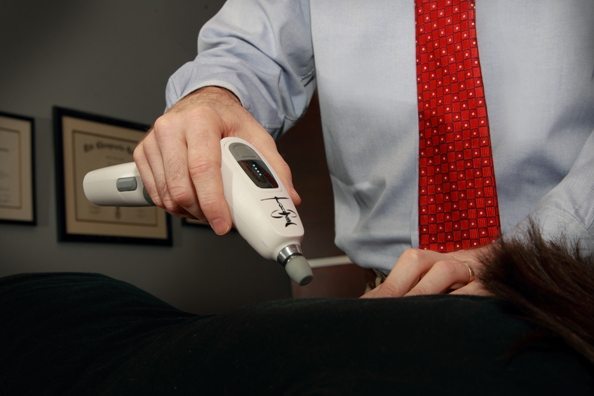







“Does That Activator Thing Really Work?”
Written on May 1, 2012 at 12:26 pm, by Dr. Ronald "Chip" Weisel, II
Category: Chiropractic Care|Tags: Activator,Activator Adjusting Instrument,Activator Methods
It happened again the other day. A new patient came into the office for an evaluation and chiropractic adjustment. She’d been a long time chiropractic consumer, and had visited several other chiropractors in the past. She and her family recently moved to the area, so she was looking for a new chiropractor.
I love this type of new patient. They are in essence pre-qualified before they walk through the door. They love chiropractic care, and want to pick up where they left off with their last chiropractor. But I have learned to ask one last question before they begin their care at our office.
“Are you aware that I use the Activator Method exclusively?”
“Yes, I saw it on your web site,” she said. “One of my other chiropractors used it on my neck sometimes.” But, I could tell by the expression on her face she was somewhat apprehensive.
“Was it a good experience?” I asked.
“Not exactly,” she said. “It didn’t seem to really work.”
“Was the doctor certified in the Activator Method?”
“I don’t know,” she replied. “Does that matter?”
“Absolutely,” I said. “Activator Methods certifies and re-credentials its doctors regularly to ensure that the technique is applied with the latest advances.”
My patient looked at me quizzically.
And there it was. I had just encountered yet another patient who thought they had an Activator experience, when in reality they did not.
What is Activator?
In the chiropractic profession, Activator means two distinct things: 1) An adjusting instrument used to manipulate dysfunctioning joints, 2) An analytical procedure using leg-length analysis to determine where, when and when not to perform an adjustment.
Patients often confuse the two. But, it’s not really the patient’s fault. Chiropractors often confuse the two as well.
While any licensed chiropractor or chiropractic student can purchase an Activator, training and certification in the use of the instrument are voluntary. This means that although most chiropractors own an Activator (or claim to use one), where, when, and why they use the Activator instrument varies immensely.
Why Does a Doctor Use an Activator Instrument?
Chiropractors generally use an Activator instrument to perform a spinal adjustment. But, there are two major schools of thought when it comes to determining why a person needs a spinal adjustment.
Chiropractic is based on the principle that spinal joint dysfunction interferes with the nervous system. Therefore, chiropractic doctors test for spinal joint dysfunction and/or interference with the nervous system to determine if the person needs a spinal adjustment. Depending on the chiropractor’s clinical experience or where they went to chiropractic school, they tend to have more clinical confidence in detecting one versus the other.
If the chiropractor has more of a “joint dysfunction” perspective, he/she will ultimately rely on tests for spinal misalignment or loss of spinal joint mobility to diagnose where to make a spinal adjustment. As a result, he/she will often thrust multiple times on one area in an effort to “move the bone” or increase spinal joint mobility. Sort of like you would use a hammer to break loose or free something that is stuck.
However, if the chiropractor has more of a “nerve interference” perspective, he/she will ultimately rely on tests for interference with the nervous system (leg length analysis, neurological reflexes) to diagnose where to make a spinal adjustment. As a result, he/she will thrust one time on an area in an effort to “reset the nervous system” or restore spinal balance. Sort of like you reset a GFIC outlet by simply pushing in a RESET button.
The Preponderance of Evidence
Research and the clinical consensus of experts trained in using the Activator adjusting instrument indicate that if you are manipulating a dsyfunctional joint, one (1) thrust per area works best. To date, seven clinical trials have been published comparing the outcomes of Activator Methods care to traditional chiropractic manipulation. Each and every one of these trials demonstrated equivalent outcomes regardless of which method was used. That means based on the evidence, the “Activator thing” really does work.
Ironically, in the one neck pain trial that had a higher proportion of temporary adverse effects (increased neck pain, mild radiating pain, mild headache, mild fatigue, etc.) than manual manipulation, “the analytical procedure associated with Activator Methods was not used.” That means there is at least some evidence that how and why one uses the Activator likely matters a great deal.
The Activator Works When It’s Used Correctly
The Activator Method uses specific protocols to detect spinal joint dysfunction that focus on analyzing leg-length inequality and testing neurological reflexes to determine where, when and when not to perform an adjustment. In addition, the Activator Method uses only one (1) thrust per area of contact to initiate the process of restoring spinal balance in the patient.
If your Activator Methods experience did not include leg-length testing, or if it involved repeated or multiple thrusts with the Activator on each area, you did not have a true experience. In fact, unless you have had an Activator Methods experience from a doctor who has a current Proficiency Rating in the Activator Methods chiropractic technique, you do not really know whether or not this method is right for you.
The Activator web site maintains a current world-wide directory of qualified chiropractors. In order to get qualified, a chiropractor must be licensed and have earned at least a Proficiency Rating in the Activator Method Chiropractic Technique. Licensed chiropractors who earn this exclusive designation have attended an Activator Methods seminar in the past year, and have successfully passed written and practical examinations.
If you have not already, you owe to yourself to try the world’s #1 instrument adjusting technique with a doctor who knows how to use it. After all, owning a hammer doesn’t make one a carpenter, right?
The Benefits of Chiropractic Discussed on The Doctors
Written on April 23, 2012 at 8:13 pm, by Dr. Ronald "Chip" Weisel, II
Category: Chiropractic Care|Tags: back pain,chiropractic care,lower back pain,The Doctors
Watch Dr. Fabrizio Mancini as he discusses the benefits of chiropractic care on The Doctors (episode originally aired on April 23, 2012).
Chiropractic care: See Dr. Mancini demonstrate the Activator adjusting instrument
Who Do You Love and Not Want to Lose?
Written on April 7, 2012 at 9:06 am, by Dr. Ronald "Chip" Weisel, II
Category: Uncategorized|Tags: 3/50 Window Display,Hartville Chocolate Factory,Hartville Hardware,Hartville Kitchen,Mi Casa,The 3/50 Project
On November 10, 2011, Christa Kozy the president of my local Lake Township Chamber of Commerce hosted nationally known speaker Cinda Baxter to talk to local businesses about The 3/50 Project. At that event, we learned about how The 3/50 Project came to be, what its grown into today, and most importantly how we could use it to strengthen our own businesses.
On that day, I became a proud (and enthusiastic) supporter of The 3/50 Project. This is true, because it can be verified on my Facebook Timeline.
One of the ideas Cinda Baxter presented was The 3/50 Project Window Display. The idea is to invite people who visit your business to write down on a postcard three locally-owned, independent businesses that they love and would not want to lose. Then display these postcards in your window, and have a contest.
So we did it. And, in just three weeks we had almost 200 postcards on display in our window. Then at the end, we held a drawing and gave away three $50 gift certificates. It was a blast. And, we learned at least two things.
First, The 3/50 Project Window Display made people think about and ask the question: “What’s an Independent?”
We used The 3/50 Project’s definition of an Independent:
1. The majority of the business’ ownership is private, by employees, the community, or an area cooperative, and is resident to the community in which it’s based
2. The business operates out of a physical storefront or similar and is the only business residing at that specific doorway’s address (not a kiosk, home based business, etc.)
3. The business relies solely on its unique name and reputation (ie, does not “wear” a regionally or nationally recognized brand name)
Second, if you are a local business owner (or work for one) listed below, we raised awareness for you and your business. You’re welcome. We hope you do the same.
Bottom line, participating in The 3/50 Project Window Display helped our business and other local brick & mortar businesses at the same time. I think that’s what they call a “win-win.” Cinda Baxter is a good genius. We love her.
Here is the list of the local, independent businesses in Lake Township that our clients and patients love and do not want to lose:
- Ashleigh Scott Salon
- Aunt Cindi’s Donuts
- Beginnings Salon & Day Spa
- Beiler’s Penn Dutch Market
- Best Bib & Tucker
- Briana’s Elite Dance Studio
- Larry D. Bucher, DDS
- Carlo’s Trattoria
- Central City Motorcars
- Concorde Therapy – Hartville
- Consign and Design Home Furnishings
- Country Clean Car Wash
- Country Flowers & Herbs
- Clearwater Park
- Creative Learning Preschool
- Dahlman’s Carpet
- Eaton Place
- Erb’s Automotive
- Excelerated Fitness & Pilates
- Faded Velvet
- Family Eyecare Center
- Frontier Restaurant
- Half Off Deals / NeoFill
- HallStar Sports
- Hartville Café & Coffee House
- Hartville Chocolate Factory
- Hartville Collectibles
- Hartville Contractors Supply
- Hartville Elevator Co.
- Hartville Hardware
- Hartville Health & Wellness Centre
- Hartville Kitchen
- Hartville Marketplace & Flea Market
- Hartville Locker Services
- Hartville Mercantile
- The Hartville News
- Hartville Sod Farm
- Hartville Thrift Shoppe
- Hartville Tire & Radiator
- The Hartville Tool Exchange
- Hartville Travel
- Hartville Veterinary Clinic
- Jim’s Autocare
- Lake Community Federal Credit Union
- Lakeview Golf Course
- Lucky Star Chinese Food
- Mel’s Barber Shop
- Meet Me At Irene’s Restaurant
- Mi Casa Mexican Restaurant
- Pastore’s Dry Cleaning
- Personal Fitness Studio
- Posh Pet
- R Grocery Outlet
- Ramsburg Insurance & Financial Services
- Seven Hills Golf Club
- Tim’s Auto Services
- TJ Nails
- Tri-County Medical Services
- Twice Is Nice Consignments
- Two E’s in a Pod
- Uniontown Veterinary Clinic
- Walden’s Barber Shop
P.S. The top five vote getters were:
-
Hartville Health & Wellness Centre
-
Hartville Hardware
-
Hartville Kitchen
-
Hartville Chocolate Factory
-
Mi Casa Mexican Restaurant
So, who do you love and not want to lose?
CLICK HERE for The 3/50 Project Window Display Postcards
What Locally-Owned Businesses Would You Miss if They Closed?
Written on March 6, 2012 at 8:38 pm, by Dr. Ronald "Chip" Weisel, II
Category: Uncategorized|Tags: 3/50 Window Display,The 3/50 Project
In March of 2009, on the heels of a week filled with particularly dire media headlines, Minneapolis, Minnesota based retail consultant Cinda Baxter wrote a blog post titled Save the Economy Three Stores at a Time in hopes of inspiring small business owners to unite under a single banner with the common goal of reigniting local consumer spending. The result was the birth of the 3/50 Project.
The Project’s tag line, Saving the Brick and Mortars Our Nation is Built On refers to its sole purpose—retention of locally owned, independent businesses, whose dollars provide a large portion of annual revenue critical to funding public resources and services
What I love about the 3/50 Project is that it has a simple, consumer-friendly message. Unlike traditional “Buy Local” campaigns, the 3/50 Project is something both retail and service businesses can rally around with the common goal of reigniting local consumer spending. And, by focusing consumers on only three businesses and $50, the Project message is simple, personal and achievable—without being exclusionary, political, or protectionist.
Consumers are asked to think of three businesses they would miss if they disappeared, then return to those businesses, with a reminder that those transactions are what keeps the doors open.
The number 50 ties to the fact that if just half the employed U.S. population dedicated $50 of their current monthly spending to locally owned independent businesses, more than $42.6 billion of revenue would be generated annually.
The 3/50 Project message explains that for every $100 spent in local, independent brick and mortar businesses, more than $68 returns to the local economy; when spent in a big box or chain, the amount drops to only $43. Spend it online, and unless you live in exactly the same community as the e-tailer, nothing comes home.
During the month of March, we are doing a 3/50 Window Display as our way of drawing attention to both the 3/50 Project and other locally-owned independents in Lake Township.
When you visit our facility during the month of March, you are invited to write on a post card three locally-owned brick & mortar businesses you would miss if they closed. We’ll post your card in the window with all the other cards and you’ll be entered to win one of three $50 gift certificates to be given away in a drawing on March 30, 2012.
Stop by, and do your part to save the brick and mortars our nation is built on. And, don’t worry, we have a lot of window space!
Why I am a Doctor of Chiropractic
Written on January 23, 2012 at 7:51 pm, by Dr. Ronald "Chip" Weisel, II
Category: Chiropractic Care, Massage|Tags: headache,lower back pain,neck pain,sciatic leg pain
Years ago, a chiropractic patient turned chiropractic advocate named Bill Esteb wrote an informal treatise of sorts for my chosen profession:
Why I am a Doctor of Chiropractic
Because I honor the inborn potential of everyone to be truly healthy. Because I desire to help the newborn, the aged, and those without hope. Because I choose to care for the patient with the disease, not the disease. Because I wish to assist rather than intrude; to free rather than control. Because I seek to correct the cause, and not its effect. Because I know doctors do not heal, only the body can heal itself. Because I have been called to serve others. Because I want to make a difference. Because every day I get to witness miracles.
Because I know it is right.
At the time, I liked it. It may have been a bit zealous in tone, but it made me feel good about being a chiropractic doctor when I read it. So, I hung it on the wall of my office. But years went by, I moved offices, changed my décor, and ended up putting the plaque in a box, on a shelf.
Out of sight. Out of mind.
Then recently a friend of mine sent me a link to a talk by Simon Sinek: How great leaders inspire action. Simon has a simple but powerful model for inspirational leadership all starting with a golden circle and the question “Why?” His examples include Apple, Martin Luther King, and the Wright brothers.
Simon Sinek reminded me of the importance of knowing (and being able to articulate) why we do what we do.
Like most other people, I know what I do. I provide chiropractic care. And, while that statement is true, who cares? Every chiropractor provides chiropractic care. So what?
Like many other people, I know how I do what I do. I specialize in Activator Methods chiropractic care. And, we often combine chiropractic care and massage. Between myself and our massage therapists we provide a full range of treatment options for neck pain, headache, sciatic leg pain, back pain—including options for post-surgical back pain and complex cases—all under one roof. But again, so what?
According to Simon, people don’t buy what we do, or how we do it. People buy why we do it.
So, I took Simon’s challenge. I asked myself, “Why do I do what I do?” As a result, here is my present day informal treatise of sorts for my chosen profession:
Why I am a Doctor of Chiropractic
Because I believe people deserve drug-free, noninvasive options
for treating pain and inflammation
that “first, do no harm.”
It may not be as quite as eloquent (or as inclusive) as the one at the top of this page, but in a world where too many people seem to act as if their aches and pains are caused by an ibuprofen deficiency, it clarifies why I do what I do.
So….why do you do what you do?
“Keep the Cheer Here” 3/50 Project Holiday Promotion
Written on December 12, 2011 at 7:37 pm, by Dr. Ronald "Chip" Weisel, II
Category: Massage|Tags: 3/50 Bundle,Biofreeze,massage,Pilates,The 3/50 Project
As an independently owned business, Hartville Health & Wellness Centre proudly supports The 3/50 Project. The 3/50 Project is about saving your local economy ….three businesses at a time.
“It’s simple. Pick 3. Spend $50. Save your local economy.”
The idea makes sense. Think about which three local, independently-owned businesses you would miss most if they were gone. Stop in and purchase something that you need. Your patronage is what keeps those businesses around.
According to founder and president of The 3/50 Project, Cinda Baxter, “If just half the employed U.S. population spent $50 each month in independently owned stores, their purchases would generate $42,629,700,000 in revenue.”
“For every $100 spent in independently owned store, $68 returns to the community through taxes, payroll and other expenditures. In a national chain, only $43 stays here.”
Hartville Health and Wellness Centre has teamed up with Excelerated Fitness & Pilates to help you “Keep the Cheer Here” this holiday season. We’ve made it easy for you to do your part to save our local economy—and benefit from some fantastic savings on products and services you can use yourself or gift to others.
Our 3/50 Bundle includes:
1. A tube of Biofreeze
2. A thirty (30) minute massage
3. A private thirty (30) minute introductory Pilates session
That’s 3 items bundled together (worth $71) for only $50!
Take advantage of this limited time offer by stopping by Hartville Health and Wellness Centre or Excelerated Fitness & Pilates. Or call 330-877-3177 today!
A Series of Unfortunate Events
Written on November 26, 2011 at 11:51 am, by Dr. Ronald "Chip" Weisel, II
Category: Chiropractic Care, Laser Therapy, Massage|Tags: back injury,back pain,lower back pain,neck pain
As a chiropractor, I see a lot of people with low back and neck pain. One of the most common questions these patients ask is, “What caused my pain?” I have found that most of these patients don’t ask this question because they want a detailed explanation of the physiology of back pain. They ask because most of the time they can’t think of anything they did that was different, yet their back hurts more than usual, or the pain is not going away on its own this time.
There is a reason for this, but it’s not what most patients want to hear.
I call it a series of unfortunate events.
For example, let’s say Joe is a 40-something man with an office job where he sits at a computer for extended periods of time. One weekend Joe helps his brother-in-law move an old couch up a flight of stairs. He feels a bit of a strain in his back, but it’s nothing a few ibuprofen don’t seem to take care of, right? Then, a week later, Joe spends some prolonged time driving in a vehicle. His back feels stiff and sore the next couple of mornings, but after an hour or so it seems to loosen up, so it’s all good. The next Saturday, Joe spends several hours on a ladder putting up holiday lights on the outside of his house. Later that evening he goes shopping with his wife where he spends an excessive amount of time standing and walking. Again, his back is stiff and sore, but nothing a few more ibuprofen won’t handle….

Get the picture?
Two days later, Joe wakes up for work and his lower back is in severe pain.
He can barely get out of bed.
He makes it through his work day sucking down more ibuprofen.
After work, Joe comes into my office for a consultation.
I ask him what happened.
Joe says, “I don’t know. I just woke up this way.”
As a chiropractor, I hear this from patients all the time.
Joe thinks he didn’t really do anything to cause his pain.
I know that it was the cumulative effect of his series of unfortunate events.
Change the name. Modify the series of unfortunate events. The outcome is the same. While back pain may be caused by some type of injury or trauma, most back pain is the result of the normal aging process combined with a series of unfortunate events, i.e muscle strains, that don’t heal as quickly as they used to.
Most people who experience low back and neck pain are not as young as they used to be. As we age, our metabolism slows down. Most people automatically associate slower metabolism with gaining weight. But, that’s only part of the story.
“Learning to respect the time it takes to recover from unusual physical activity can go a long way toward preventing back and neck pain.”
Slower metabolism also means longer rest and recovery. Technically mitochondria in the cells slow down with age (think of mitochondria as little energy factories in cells that convert nutrients to power). This means that when we do physical activity it takes our bodies longer to recover. That is why a series of unfortunate events catches up with us now when it did not seem to when we were younger.
When we were younger, most of our aches and pains seemed to resolve spontaneously.
That was then. This is now.
Now that we are not as young as we were, giving our bodies enough rest and recovery after physical activity is even more important.
Typical events that can lead to back and neck pain:
- Reading or doing tasks for extended periods of time while looking down
- Sitting in a bad armchair and/or in an uncomfortable position
- Lifting and twisting repetitively e.g. raking leaves, shoveling snow
- Carrying or moving heavy items e.g. furniture
- Holding phone between neck and shoulder
- Watching TV in incorrect position e.g. too much to the left/right
- Sleeping with head slumped forward e.g. while traveling
- Sitting in the same position for a long period of time
- Standing in the same position for a long period of time
- Sleeping on a bad bed/mattress
So, if series of unfortunate events has caught up with you, we can help. Complementary and alternative options like chiropractic care, laser therapy, and massage have all been shown to be safe and effective ways to help you get back faster.
Chiropractic care is not for everyone.
Written on October 18, 2011 at 5:28 pm, by Dr. Ronald "Chip" Weisel, II
Category: Chiropractic Care|Tags: chiropractic care,chiropractor,headache,lower back pain chiropractic,neck pain,neck pain chiropractic,sciatic leg pain,upper back pain
Chiropractic care is not for everyone. Chiropractic care is a drug-free, noninvasive way to manage pain and improve function. Chiropractic care is not a “cure all” for any and all health problems. Chiropractic care has been shown to be very effective for relieving a variety of common conditions like lower back pain, sciatic leg pain, neck pain, and headaches. But, because these types of aches and pains can have a variety of causes, it is important to consult with a doctor of chiropractic to determine if your condition would be responsive to chiropractic care.
NOTE: Only a chiropractic doctor (not Dr. Oz; we love him, but he is only a cardiologist) can tell you if your condition may be helped with chiropractic care.
What’s causing your neck or low back pain? Most neck and back pain is caused by dysfunctional spinal joints that cause over-active spinal nerves.
Chiropractic manipulation is believed to calm these nerves.
ABOUT CHIROPRACTIC CARE
Chiropractic is a health care profession that focuses on the relationship between the body’s structure—mainly the spine—and its functioning. Although practitioners may use a variety of treatment approaches, they primarily perform adjustments (manipulations) to the spine with the goal of alleviating pain, improving function, and supporting the body’s natural ability to heal itself.
Who should NOT use chiropractic care:
- Anyone whose pain is not being generated by joint dysfunction.
- Anyone who prefers to mask their back and neck pain with NSAIDS.
- Anyone who thinks pain is normal, and can “live with it.”
- Anyone who just wants instant, temporary relief from pain.
BEFORE STARTING CHIROPRACTIC CARE
Chiropractic doctors are portal-of-entry physicians. This means you do not need a referral to consult with or be examined and treated by a chiropractor. So, tell your chiropractor about all your medical conditions and medications so he/she can make an accurate diagnosis.
POSSIBLE SIDE-EFFECTS OF CHIROPRACTIC CARE
Reactions following chiropractic manipulations are minimal. The most common reaction to chiropractic adjustment spinal manipulation is temporary aching or soreness in the spinal joints or muscles. If this aching or soreness occurs, it is usually within the first few hours post-treatment and does not last longer than 24 hours after the chiropractic adjustment. An ice pack often reduces the symptoms more quickly.
On the most extreme side of chiropractic-related problems, vertebrobasilar artery (VBA) stroke, have been reported and critics of chiropractic care use this by recommending no spinal manipulation of the cervical spine.
The alleged association between and chiropractic visits was recently compared and contrasted with primary care physician (PCP) visits and vertebrobasilar artery stroke. According to the authors of this particular study published in Spine:
There was “no evidence of excess risk of VBA stroke associated chiropractic care compared to primary care.”
In reality, because the chances of serious side-effects from chiropractic manipulation are extremely remote, chiropractors enjoy very low malpractice insurance rates compared to other specialties.
HOW TO TAKE CHIROPRACTIC CARE
Do:
• Follow the treatment plan exactly as your chiropractor recommends.
• Manage your expectations. Most conditions did not happen overnight and therefore do not respond overnight. Often times you will feel no different right after an adjustment. However, most conditions do show significant improvement within the first few sessions and/or two weeks of care.
• Take it easy for the first two (2) hours after a treatment session. Even if you feel better, allow time for your body to respond to your adjustment. There is a difference between feeling better and being stable.
Don’t:
• Don’t change or stop your treatment plan by canceling or missing appointments without first talking with your chiropractor.
• Don’t use a heating pad, but if you must, use it for no more than twenty (20) minutes at a time.
• Don’t use any more pain relief medication than you absolutely need. It is very important that you know your body’s limitations or your condition may be exacerbated, and your recovery may be delayed.
Chiropractic care can provide significant relief from back and neck pain.
In some patients, chiropractic works in as early as the first week of treatment.
To learn more visit www.GetBackFaster.com or call 330-877-3177
How to Choose a Massage Therapist
Written on September 8, 2011 at 9:48 am, by Gin Rhodes, LMT
Category: Massage|Tags: massage,massage therapy
Massage therapy, when done well, is a multi-faceted treatment. Everyone is different. Some people prefer someone who is approachable and talkative. Others are looking for someone more businesslike. And, because our bodies are so very personal – having someone put their hands on it to treat it is so intimate – having the right type of therapist is crucial.
What makes a great massage therapist? There are so many intangibles, how could someone sort through all of them, particularly before having a massage or following one of their first sessions? How does one know what to look for?
Let me answer those questions from my point of view as a massage therapist. First, we are all different and have different needs, so naturally what works for me may or may not work for you. (that’s my disclaimer) When I look for a massage therapist, I am looking for someone who will be sensitive to my needs – physically, socially and emotionally.
From a physical standpoint, clearly a good therapist understands human anatomy and how it all works together. Additionally, it’s important to be aware of how much pressure a person needs and/or can tolerate. Many people come in looking for a treatment that they can “feel” and not only expect a little discomfort during treatment, but would not feel as though they had been treated if they did not “feel” the massage. Other people can barely stand to be touched because an area is so sensitive, so even though on one person a great deal of pressure and stretching might be typical, on another a much more gentle approach is required.
From a social standpoint, I am referring to the massage therapists’ manner – a therapist who is all business or seems more friendly, a clinician versus a new-age-hippie type, someone who is chatty versus quiet. All of these approaches to the table can be good and appropriate, but not to everyone. And because there are so many different kinds of people who have all different kinds of moods, a good therapist will be responsive to the clients needs without losing their own identity. So, if you are a quiet type and start out with a chatty therapist, a good (and sensitive) therapist will know to quiet down and respond in the way that is right for you.
And finally from an emotional standpoint, a conscientious therapist is constantly aware of their client’s state of mind. No one (in my experience) comes for a massage looking for judgment. Generally, they just need a little support with whatever is on their heart or mind on a given day, which is often just a matter of being present with them. And sometimes complete amnesia the next time they’re seen. Emotions happen, particularly when we are feeling physically drained or strained or vulnerable. No worthwhile massage therapist would ever try to capitalize on or make judgments on a client’s emotional state.
In any setting, from the clinical to the completely luxurious, the massage therapist’s role is a nurturing one. No therapist should make you feel uncomfortable, and it is always acceptable to end a session if you feel that their behavior is inappropriate – just as a therapist would end the session if a client/patient/guest were to speak or behave in an inappropriate manner.
Choosing a massage therapist is a very personal thing. And like all people, all therapists have their own individual strengths and weaknesses. Knowing what works for you particularly in these three categories should help you find the one who’s right for you.
Why We Don’t Take X-rays
Written on June 21, 2011 at 10:40 am, by Dr. Ronald "Chip" Weisel, II
Category: Chiropractic Care, Laser Therapy, Massage|Tags: back pain,lower back pain,x-rays
When it comes to low back pain and routine x-rays, less is more.
Treatment plans for lower back pain no longer require routine x-ray imaging. A recent meta-analysis of six randomized controlled trials of 1,804 patients with acute or sub-acute lower back pain and signs or symptoms of a specific underlying condition did not find a difference in terms of pain, function, quality of life or overall patient-rated improvement whether routine lumbar imaging was performed.
Most abnormalities noted on x-rays are common in people without low-back pain and are loosely associated with back pain symptoms.
Today’s chiropractic care using the Activator Method® does not require the use of x-rays in order to initiate the process of restoring spinal balance in a patient. Instead, this instrument-based chiropractic technique utilizes specific protocols to detect spinal joint dysfunction, analyze leg length inequality, identify issues with body mechanics, and test neurological reflexes.
Evidence-based recommendations within the field of chiropractic care clearly define* when x-rays are needed for patients with low-back pain:
- Recent trauma with suspicion of injury
- Severe or progressive neurological deficit
- Non responsive to four (4) weeks of conservative treatment
Granted, x-rays will commonly be required as a preliminary study when referral for other studies are needed, such as an MRI or CT.
Even the American College of Physicians (ACP) recently found strong evidence that routine x-rays does not improve clinical outcomes and may expose patients to preventable harm. However, in a recent survey approximately 40% of internal medicine physicians reported ordering routine x-rays for acute low-back pain.
Adhering to the best current evidence about the use of imaging reduces overuse. Most chiropractic patients do not need immediate imaging and will benefit from an initial trial of chiropractic, massage or laser therapy. Key chiropractic management principles to guide imaging decisions include a thorough history and physical examination, as well as effective communication with the patient.
In the unusual event that Dr. Weisel determines x-rays are necessary, he has radiology privileges at Mercy Medical Center, and can order an necessary tests.
In the end, at Hartville Health & Wellness Centre we do not take x-rays because we are committed to providing all the care and only the care known to be effective.
Source:
*Souza TA, Differential Diagnosis and Management for the Chiropractor: Protocols and Algorithms, 4th Ed. Sudbury (MA): Jones and Bartlett Publishers; 2009. p. 26.